

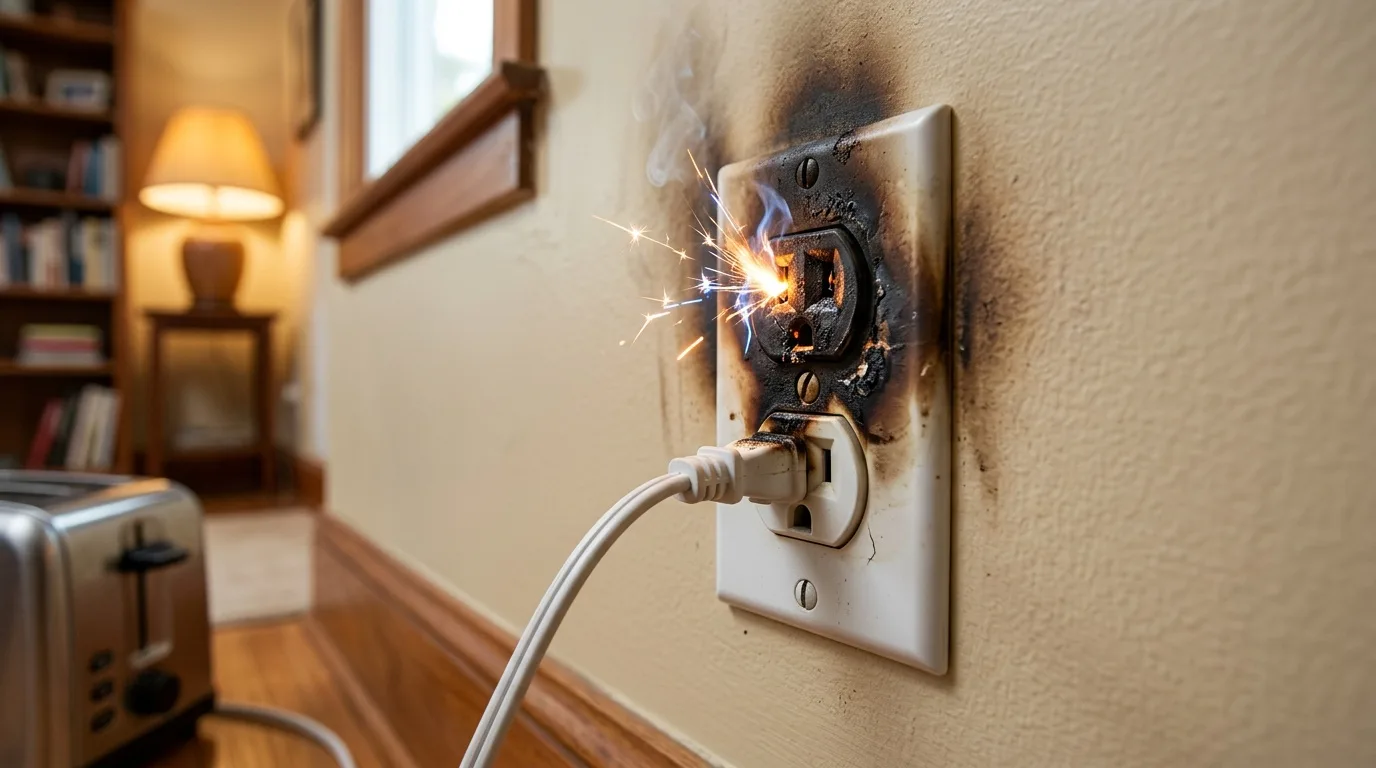
Outlet sparking when plugging in an appliance is common, and many people don't pay any attention to it. Sometimes that's fine. Sometimes, though, sparking points to a serious wiring problem and can lead to a fire.
Sparking happens when current jumps through the air between contacts. Over time the gap gets bigger, and the risk of overheating or fire grows with it. Below we cover when a spark is normal, which signs mean danger, where the problem comes from and what to do. We also cover what to do about the smoke residue afterwards.
A Normal Tiny Spark vs. Danger
When you switch on a refrigerator, vacuum, hair dryer or washing machine, there's a brief surge of current. If there's a small gap between the plug prongs and the outlet contacts at that moment, the air ionizes and a spark appears.
That kind of flash is usually white or bluish. It happens once and goes out right away. Only that single, barely visible flash at the moment the prongs touch the contacts counts as normal. A single spark when you turn on a powerful appliance comes from the current surge and is usually not dangerous.
Repeated sparking is common, but that doesn't make it normal. It can damage appliances, burn out the outlet, start a fire and give people an electric shock, so it needs to be fixed promptly.
Warning Signs
- Regular sparking. The outlet sparks often, not once in a while.
- Bright yellow or orange flashes. Especially when they come with crackling.
- Crackling, hissing or buzzing. Any of these sounds means something is wrong.
- Outlet burning smell. The smell of burning or heated insulation.
- Heat. The outlet cover is warm or hot to the touch.
- Scorch marks on outlet. The contacts have darkened, or the finish around the outlet has darkened.
The situation has to be judged as a whole: the condition of the outlet, the age of the wiring, the load on the circuit and the appliances themselves all matter.
Is a Sparking Outlet Dangerous?
Yes, when the sparking goes beyond that one flash. An electric arc heats the contacts strongly. This can melt the outlet housing, damage the wire insulation and lead to a short circuit or a fire.
A poor contact can also cause voltage drops and interference. A wire that has shifted can touch a metal part of the outlet and give someone a shock.
Standard breakers in the panel don't trip on this kind of sparking. Arc-fault circuit interrupters (AFCIs) help against it, but many homes don't have them.
Outlet sparking and smoking, or an outlet burning smell, should never be ignored in the hope it will go away by itself. Electrical wiring, switches and outlets are among the most common causes of house fires. The U.S. Fire Administration electrical safety sheet gives general rules for preventing them.
Why an Outlet Sparks: Loose Connections, Old Wiring and Other Causes
Sparking is not always tied to wear of the outlet itself. The quality of the contact depends on the state of the wiring, how secure the connections are, the load and the operating conditions. The problem usually develops gradually, so people in the home can often spot it in advance by indirect signs.
A Worn Outlet
An outlet contact is designed for a limited number of plug-in cycles. Over time the spring contacts lose their springiness and don't grip the prongs well. The contact area shrinks, the resistance at the contact point goes up, and the outlet overheats, especially with powerful appliances.
Signs:
- The plug goes in with almost no effort. It doesn't take the usual push.
- The housing heats up. You can feel it with your hand.
- Darkening appears. On the contacts or around the slots.
Loose Wires in the Terminals
Over time the connection between the wiring and the outlet terminals becomes less reliable. Because of constant heating and cooling, the terminal screws loosen and the contact gets weak. The wires get room to move in their terminals, and the electrical resistance at the contact point goes up. This happens especially often with old aluminum wiring.
At an early stage this is hard to notice. Indirect signs:
- Smell of heated insulation. Even faint, it is a reason to check.
- Darkened finish around the outlet. On the wall plate or the wall itself.
- Flickering. Lights or appliances plugged into the outlet flicker.
Loose mounting screws can also weaken the contact.
Overloading the Circuit
An appliance can draw more current than the outlet is rated for, or too many devices can run on one circuit at the same time. The contacts overheat, the metal degrades, and sparking appears. The consequences pile up without anyone noticing.
Old Wiring
Old wiring may not handle high-power appliances like microwaves or washing machines. This is a warning sign in itself. It's worth having an electrician check what kind of wiring the home has.
Oxidation, Dirt, Moisture and Installation Mistakes
- Oxidation and buildup. Oxide, dirt and carbon deposits on the contacts make the connection worse.
- Dust, moisture and foreign objects. They disrupt the contacts and can cause sparking or a short circuit. Damp rooms may need GFCI-protected outlets, and children should be kept away from outlets.
- Poor-quality hardware. Cheap outlets made of soft plastic and thin metal can have contact gaps that are too large.
- Installation mistakes. If the wiring is new and the outlet still sparks, the cause may be an error during assembly and hookup.
Outlet Sparking With Nothing Plugged In
A spark that has nothing to do with a plug going in points to the connections behind the cover, not to the contact with the plug. Here the same rule applies as with regular sparking: stop using the outlet and cut the power at the panel.
What to Do If an Outlet Sparks
If the outlet is crackling right now, don't yank the plug out by the cord while it's live. Under load, an even bigger arc will flash. Switch the appliance off with its own button first, then turn off the breaker for that circuit.
- Flames or smoke from the outlet or the wall? Get everyone out and call 911 from outside. Never throw water on an electrical fire.
- Turn off the appliance and the breaker. Switch off the appliance with its button and cut power to the line at the panel.
- Inspect the plug and cord. After the power is off, look at the plug and the cord. If they are charred or melted, the appliance must not be switched on again until it is repaired.
- Inspect the outlet. Scorch marks, melted plastic and deformed or cracked contacts point to overheating and wear. Such an outlet has to be replaced.
- Don't use the damaged outlet. Cover it so nobody uses it by accident.
- Check the terminals. If the outlet itself looks intact, have an electrician check the wiring connections and terminals. Any inspection or repair is acceptable only after the line is fully de-energized.
Call a Licensed Electrician
Call a licensed electrician. The electrician can tighten the terminal screws or replace the outlet, after first making sure there is no voltage.
If sparking, heat or the smell of overheated insulation remain after the outlet is replaced, the cause is likely in the connections or the wiring. Then the whole circuit needs professional diagnostics with specialized equipment. If the wiring is old or the cause isn't clear, an electrician is needed too.
How to Protect Your Appliances and Wiring
- Spread the load. Don't plug several powerful appliances into one outlet. A microwave, a toaster and a space heater are better on different circuits.
- Don't use damaged equipment. No appliances with damaged cords or contacts.
- Inspect regularly. Look over the outlets at least once a year, have the wiring checked by an electrician, and react to the first warning signs.
- Switch off before unplugging. Turn appliances off with their own buttons before pulling the plug.
- Insert plugs fully. Never force a three-prong plug into a two-slot outlet.
- Keep outlets away from dust and damp. Where possible, don't place them in dusty or wet areas.
Smoke Residue Afterwards
A burned outlet often leaves soot on the wall plate and the wall around it, and the smell of burned plastic can stay in the room. Once the electrician has dealt with the cause, that residue still has to be cleaned. If the outlet did catch fire, the cleanup is a job for fire and smoke damage restoration. When belongings have to be moved out while the rooms are cleaned, see our contents pack-out and storage services.
For a fire that started in the kitchen, there is a separate guide on cleaning up after a kitchen fire. Outlets near sinks and in rooms that have been flooded are also at risk, since moisture is one of the causes of sparking; that is covered under water damage restoration in El Cajon.
You can read more about our restoration company, see what El Cajon customers say, browse more home safety articles or go back to the El Cajon restoration home page.