

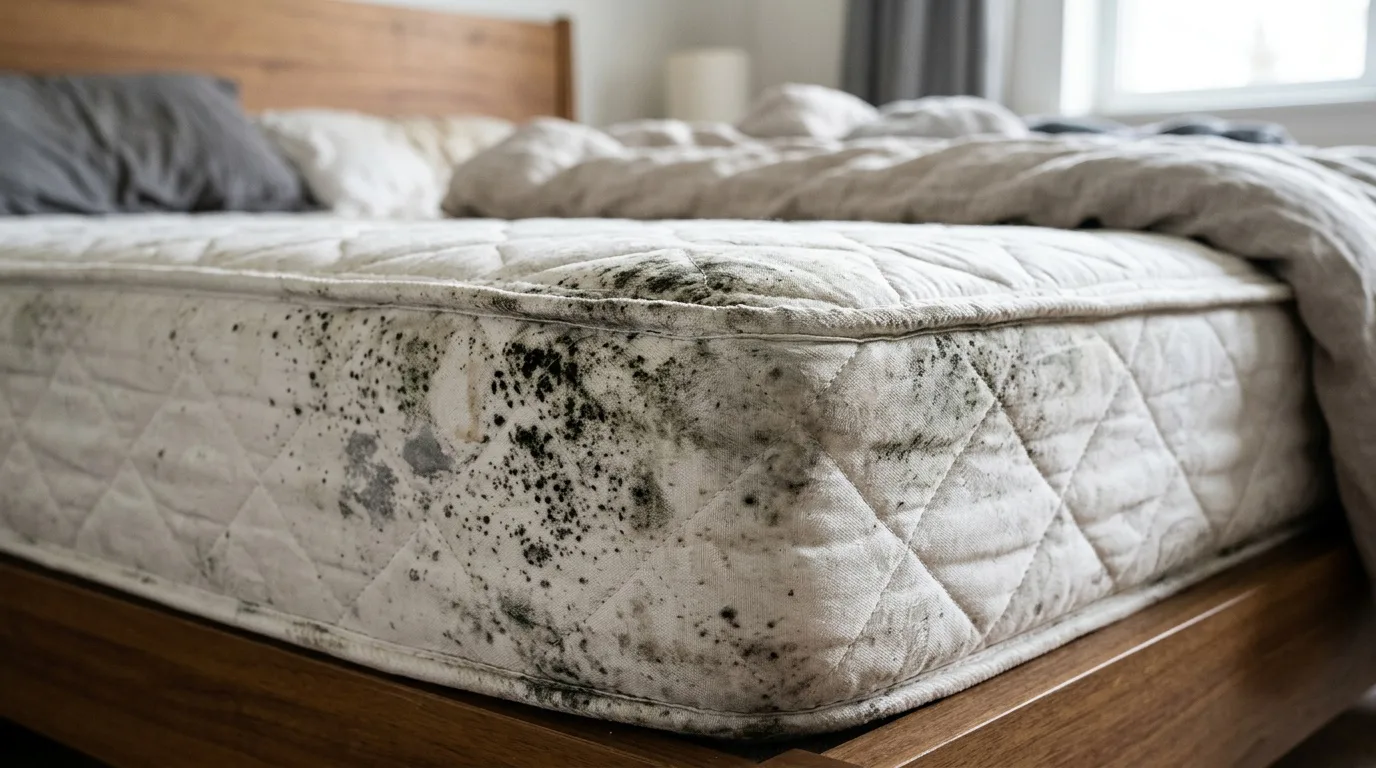
Mold in a mattress is almost never only on top. The mycelium grows down into the filling, and the dark dots on the fabric are just the tip. A fresh surface spot the size of a coin can still be treated and dried out completely. If spots are coming through on the underside, the smell does not leave after drying, or the mold comes back, the mattress has to be replaced. Home remedies do not fix that.
Mold on a mattress is not rare, and it does not mean a house is kept badly. It shows up most often in tidy homes. The mattress just sits the wrong way, or the room is too damp. Below we go through what mold looks like and how it differs from ordinary yellow stains, why it starts under the mattress, why it is dangerous, what you can really do yourself, and when it is better to say goodbye to the mattress right away instead of spending a weekend on cleaning that will not work.
Signs of Mold in a Mattress: How to Tell It From Stains
The first thing to do is figure out whether it is mold at all. People often confuse it with ordinary yellow stains, and the other way around: they panic over a yellow spot with no fungus in it, or they sleep calmly on a musty mattress and call the gray film "just dust."
Mold looks like small dots and blots that gather into a patch with blurry edges. The color is black, dark green, gray, sometimes with a blue tint. Black mold in a mattress is usually the easiest to see: the dots are sharp and fine, as if someone shook ground pepper over it, and a damp cloth does not wipe them off, it smears them. The surface in that spot can feel slightly velvety or look fuzzy against the light.
The second sign is smell. A typical musty, earthy, damp odor that gets stronger when you lean over the mattress or press it with your hand. Fabric softener does not cover it, and it comes back a day after the bedding is washed. If the sheets smell fresh but the room still feels damp in the morning, the source is most often the mattress.
The third sign, and the most telling one, is the underside. Lift the mattress and look at the bottom and at the bed base itself. Mold almost always starts underneath, where there is condensation and no air. If on top you see one small spot, and underneath it there is a wide dark field, that is not the start of the problem. That is the end of it.
Signs that point to mold:
- Dots and blots: black, green or gray, with a blurry edge.
- It smears: it does not wipe off, it spreads.
- The smell: musty, like a damp basement.
- The underside: spots on the bottom of the mattress and on the base.
- Growth: the spot gets bigger over time.
Signs of an ordinary stain:
- Even outline: yellow and rusty marks with a sharp edge.
- Known source: sweat, drool, spilled tea, children's accidents.
- No damp smell: just a not-so-fresh smell.
- Same size: the spot stays the same for years.
Yellow stains are mostly oxidized proteins from sweat and dust. They are ugly, but they are not alive: they do not grow and they do not smell musty. Mold is a living organism, and the main difference is that it spreads. A spot that got noticeably bigger in two weeks is mold, not dirt.
Why Mattresses Mold
Mold needs three things: moisture, warmth and no air movement. A mattress gives it all at once. It is warm after sleep, it absorbs moisture, and it lies flat and tight. Mold spores are always in the air, in any home; nobody has to bring them in. The only question is whether you give them conditions.
Sweat and Condensation Between the Mattress and the Base
This is the main cause. Over a night a person gives off a fair amount of moisture. Part of it goes into the air, part goes down, into the mattress. At the bottom the mattress rests on a cold base, the moisture reaches it, cools and settles as condensation. In the morning you make the bed, and that water stays inside all day, in the dark and warm. Ideal conditions.
A Solid Base Instead of Slats
The second most common cause. A mattress on a solid sheet of plywood, particleboard or a solid metal platform breathes poorly from below. A slatted base with gaps between the slats solves half the problem by itself: air moves underneath, and the mattress dries out during the day. A solid platform lets the underside dry more slowly than slats, a box spring or a foundation with an open frame, so in a damp room that is often where mold starts.
A Mattress on the Floor
A mattress laid straight on the floor is the most common case. The floor is colder than the air, condensation collects over the whole area, and there is no ventilation. The same goes for a mattress put on the floor "for now" during a remodel or for guests: a few weeks in a damp room can be enough for dots to show on the bottom.
Humidity in the Room
If bedroom humidity stays above 60%, mold can start even on a normal slatted base. It is best to keep indoor humidity below 60%, ideally between 30% and 50%. A hygrometer costs very little and settles any argument about whether "it is damp in here or not."
Spills, a Leak and Poor Drying
A glass of water, tea, a child's puddle, a mattress washed with a steam cleaner: all of it goes deep into the filling. On top, the fabric dries in a couple of hours, and the person thinks everything is fine. Inside, polyurethane foam or a felt layer holds water for weeks. That is how mold in a foam mattress usually starts. A month later the smell appears, another month later the spots.
Closed Rooms, Food and Other Causes
A guest room or a vacation home that stays shut for months. The air stands still, the moisture does not leave, the temperature stays warm. After a season the owners come back and find the mattress covered in black dots.
A few more causes are worth listing:
- Mold already in the room: if a room already has affected areas, the fungus will reach the mattress too.
- Eating and drinking in bed: crumbs and spilled liquids help mold grow.
- Body fluids: fungus often appears on children's mattresses after bedwetting.
- Wet filling after cleaning: the mattress must be dried thoroughly, because leftover liquid creates good conditions for mold.
Why Mold in a Mattress Is a Health Concern
A mattress is what you press your face against for eight hours straight. Whatever grows inside it, you breathe all night, and no distance helps here.
Mold spreads by spores. Every time you sit on the bed, lie down, turn over or fluff the mattress, spores rise into the air and end up right where you breathe. Mold also gives off gases. They give that musty smell, which slowly soaks into the bedding, the closet and the room.
In some people this causes allergic reactions: a stuffy nose in the morning, sneezing, red eyes, itchy skin. People with sensitive airways may get a cough and trouble breathing, which get worse at night and in the bedroom and ease when the person leaves home. Children, older people and people with allergies react the hardest.
A list of symptoms cannot tell you whether they come from the mattress. If you or someone at home has ongoing breathing problems, skin problems or an unexplained allergy, see a doctor. But a moldy mattress should leave the bedroom until it is cleaned or replaced, whatever the symptoms.
Can a Moldy Mattress Be Cleaned?
There is a narrow case where a mattress really can be saved: the spot is small, appeared recently, is only on the top side, the bottom is clean, and there is no smell or it is barely there. For example, water got on the mattress, nobody dried it, and a week later a spot showed up. Then the order is this:
- Put on an N-95 respirator, gloves and goggles. Not "preferably" but required: you will be raising spores into the air right in front of you.
- Take the mattress outside. All the treatment is done outside the living space; otherwise you just spread spores through the whole home and a month later find mold somewhere else.
- Go over it with a dry stiff brush. Carefully, without rubbing it in, remove the top layer. A wet rag at this stage only drives the fungus deeper.
- Vacuum it. Outside, without fail. Right after that throw out the bag, wash and dry the canister, and wash or replace the filter, or the vacuum will carry the mold around.
- Treat the spot. Hydrogen peroxide, an alcohol-based antiseptic or a special antifungal mold product for fabrics, used per its instructions, will do. Apply it to the spot only, without soaking: extra moisture in the mattress is what started all this.
- Dry it completely. This is the most important step and the one most often skipped. The mattress needs several hours in the sun and a breeze, and then a day on its edge in a ventilated room. Not "until the top is dry," but all the way.
Under no circumstances wash the mattress with a steam cleaner or pour water with baking soda over it "to be sure." Steam and water are exactly what you feed the mold with. A mattress washed heavily at home stays wet inside for weeks, and the next spot will be bigger than the first.
Why Cleaning Usually Does Not Help
Here we have to say something unpleasant. In most cases fighting mold in a mattress is pointless, and it is better to know that before you spend your weekend and money on products.
Mold is not dirt on the surface. It is mycelium: a network of very fine threads that grows into the thickness of the filling. What you see on the fabric is the fruiting part, the tip. Most of the fungus is inside, in the foam, the felt, the fiber batting, between layers, in the spring unit. No brush, vacuum or antiseptic reaches there. Liquid does not soak the filling evenly, and if it does, you get a mattress wet all the way through that cannot be dried at home.
So the typical story goes like this: a person scrubs the spot, it disappears, everyone is happy. Three or four weeks later the spot comes through in the same place, because the mycelium did not go anywhere. You cut off its tip and added moisture. A second round gives the same result.
When to Replace the Mattress
The EPA's mold cleanup advice says that absorbent or porous materials, such as ceiling tiles and carpet, may have to be thrown away if they become moldy. A mattress is a porous material as well. There are signs that close the question and leave nothing to discuss. Check the list. It takes two minutes and saves a month of useless fighting.
- The musty smell does not leave after full drying. The mattress stood for a day in the sun and a breeze, and the damp smell stayed. That means the mycelium lives inside.
- There are spots on the underside and inside the cover. If the cover zips off, open it and look at the filling. Dark marks on the inside of the cover or on the filling itself are the verdict.
- The mold came back after treatment. One return is enough. A second try is not needed; the result will be the same.
- The spot is bigger than a palm, or there are several. That is no longer a local case but a colonized mattress.
- Someone at home developed an allergy or breathing problems. Here the argument with the mattress ends at once, whatever the size of the spot.
- The mattress is old. If it is seven to ten years old and moldy on top of that, there is nothing to save. It has already served its time.
When you throw a mattress out, do not drag it across the home uncovered and do not leave it in the garage "for later." Wrap it in plastic sheeting or a big bag right in the room and carry it out. And be sure to check the bed base: if there was mold on the mattress, it is almost certainly on the slats or the panel too. They need to be washed with a disinfectant and dried, or the new mattress will mold the same way.
Bed Frames and Airflow
The good news is that after the mattress is replaced, the problem does not have to repeat. Mold does not show up by chance, and all its conditions are removed with fairly simple things.
Let the Mattress Breathe From Below
A base that lets air reach the underside is the basis: slats with gaps, a box spring or a foundation. There should be air between the mattress and the floor: a bed on legs, an open space underneath, and no boxes or suitcases stored under the bed. They block the airflow as well as a solid panel does. A mattress on the floor is out, even temporarily.
Keep Humidity in Range
The target is below 60%, ideally 30–50%. Air out the bedroom in the morning for at least ten minutes, in winter too. In damp homes a dehumidifier or the dry mode on an air conditioner helps. A hygrometer in the bedroom takes the guessing away.
Do Not Make the Bed Right After Sleep
A simple habit with a big effect. Pull back the blanket and let the mattress stand open for half an hour to an hour while you have breakfast. In that time the night's moisture goes into the air instead of staying inside all day under the bedspread.
Flip It and Lift It
Every three months rotate the mattress head to foot (flip it only if the maker says it is two-sided), and look at the underside and the base while you are at it. That is your regular check: the problem is visible at a stage when it can still be fixed.
Use a Mattress Protector
A waterproof mattress protector shields the mattress from moisture and spills: it takes the hit itself and goes into an ordinary washing machine. It is the cheapest insurance of all, and it makes the most sense where there are children, pets or just high humidity in the home. Just remember: a protector saves you from sweat and things spilled on top, but not from condensation underneath. Only ventilation works there. If mold in a mattress protector or in a mattress topper does show up, that layer needs the same check as the mattress under it.
A few more rules to keep mold from coming back:
- Air the room regularly: and keep the ventilation system clean.
- Protect children's beds: if a child wets the bed, put down a waterproof sheet.
- Change bedding often: and dry pillows and the mattress in the open air.
- Do not eat or drink in bed.
A Mattress After Water Damage
Everything said above about spills applies even more to a leak or a flood. On top, the fabric dries in a couple of hours. Inside, foam or felt holds water for weeks, and that is where mold starts. A mattress that stood in water, or was soaked by a leak from above, falls under the EPA's advice for porous materials. The longer water stays in a room, the more of the home's contents end up in the same position, so the guide on why fast water extraction matters for floors is worth reading too.
If the bed got wet in a bigger leak, the room needs water damage restoration and drying in El Cajon, not just a new mattress. Furniture and belongings that can be saved can go out of the wet rooms through pack-out services for home contents. If mold is already on the walls, the base and the mattress, look at professional mold remediation for El Cajon homes. You can read who our restoration team is, what homeowners say in customer reviews of our work, and more about water, fire and mold on our restoration news and articles page or the El Cajon restoration company homepage.
In short, mold in a mattress is almost always a ventilation problem, not a cleanliness problem. A fresh small spot on a dry mattress with a clean underside can be treated and dried, and that will be the end of it. But when the smell does not go away, spots show on the underside or the fungus comes back after treatment, there is one honest answer: the mattress has to be replaced, because the mycelium cannot be cleaned out of the filling at home. And along with the new mattress, deal with the cause: a slatted base with gaps, humidity below 60%, an aired-out bedroom and a mattress protector will do more than any product from a hardware store.