

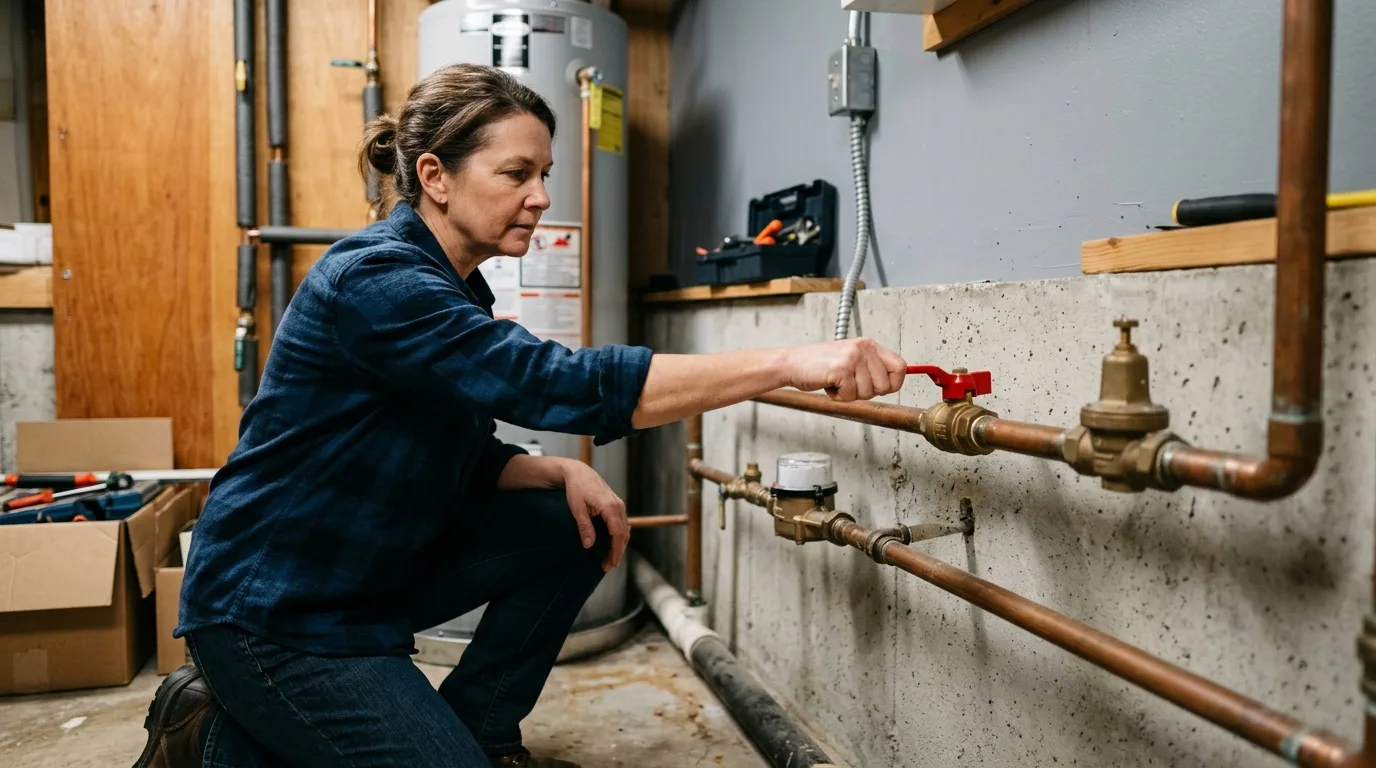
Sooner or later, the water in a house has to be turned off. A pipe leaks, a fitting under the sink lets go, a faucet or a toilet has to be replaced. Some people only start looking for the main shut-off valve once there is already water on the floor. It is better to know this in advance.
Below: when the water is shut off, where the valve is usually found in a Southern California home, how the different valves are built, how to look after them, and what to do if the valve will not turn.
When You Need to Turn Off the Water
The water is shut off in several situations. Not all of them are emergencies.
- Leaks and broken fixtures. A dripping connection, a cracked supply line, a toilet that will not stop running.
- Repairs and installation. Before replacing a faucet, a toilet or a water heater.
- A long time away from home. If nobody is in the house for weeks, the water is better turned off. A small leak with no one there to see it does a lot of damage.
- Saving water. Even a small drip runs up the bill. The EPA WaterSense leak-check guide describes how to look for such leaks around the house.
- Prevention. A valve that is never turned seizes. Turning it from time to time keeps it working.
Ways to Turn Off the Water
Water can be shut off at three levels.
- The whole street or building. This is the water department or, in a condo, the building management. A homeowner does not do this alone.
- The whole house. This is the main valve.
- One fixture. A separate small valve under the sink, behind the toilet, on the water heater line.
For a sink, a toilet or a bathtub, start with the small valve at the fixture. Only if that does not help, or there is no such valve, go to the main one.
Where the Main Valve Usually Is in a Southern California Home
Most houses here have no basement, so the valve is not where older guides tell you to look. The main water shut off valve in house plumbing is normally near the point where the water line comes in from the street.
Where the line enters the house
Find the side of the house facing the street and the meter. The line usually comes up out of the ground and enters through the wall or the slab. The valve is often within a few feet of that spot.
On a front wall near a hose bib
Outside, look at the front or side wall first. In many houses a pipe rises from the ground next to an outdoor faucet, and the valve sits on that riser, sometimes with a pressure regulator next to it.
In the garage
In some homes the line runs into the garage. Check the wall shared with the house and the area around the laundry hookups.
By the water heater
The water heater has its own valve on the cold line going in. It shuts off the heater only, not the house. Still, in some homes the main line passes close by, so it is worth checking that corner.
In a condo or apartment
In a condo, the valve owners can reach is often in a utility closet, under the kitchen or bathroom sink, behind an access panel, or near the water heater. Sometimes there is no valve for one unit at all, and the line is closed only by building staff. Ask the management where your unit's valve is and who is allowed to use it.
If you still cannot find it, check the inspection report from the purchase of the house; the location of the valve is often noted there. A plumber can also show you.
The Meter Box
Near the curb or sidewalk there is usually a concrete box with a lid. The meter is inside, and next to it there is a valve too. That side of the meter belongs to the water department. It is turned with a special key and is not meant for the homeowner. If the house-side valve is broken or cannot be found, call the water department rather than forcing the valve in the meter box.
Gate Valve or Ball Valve
Two types of valve are found on home water lines. They work differently, and it helps to know which one you have.
Ball valve
Inside the body there is a ball with a hole through it. A turn of 90 degrees opens or closes the flow completely.
- Position is visible. The handle parallel to the pipe means open. Across the pipe means closed.
- Fast. It closes in one movement, which matters in an emergency.
- Only open or closed. Most ball valves are made only for shutting off. They should not be left halfway.
- Can seize. If it stands for years in one position, it may not turn when needed.
- Hard to repair. When it fails, it is usually replaced as a whole.
Why not halfway: in the open position the seal ring is pressed by the ball and hardly wears. Closed, there is no flow, so no wear either. In an in-between position the flow hits the seal directly. It wears fast, especially if there is grit in the water, and deposits form. After that the valve no longer closes tight.
Gate valve and other multi-turn valves
These have a round handle. A stem goes down as you turn it and presses against the seat. To close, it usually takes from two to five turns or more.
- Closes slowly. Less risk of water hammer, but in an emergency it takes time.
- Repairable. The gasket or the packing can be replaced without removing the body.
- Wears. Rubber gaskets harden, and the packing nut around the stem needs tightening now and then. Grit and scale speed up the wear.
A ball valve can last many years. A multi-turn valve wears sooner, with the gasket needing replacement now and then, though the body can last much longer. For a main shut-off, a ball valve is the more common choice because it closes quickly and fully.
Test the Valve Twice a Year
Mineral salts settle inside the valve over time. How fast depends on the water. A valve that is never moved will one day not move at all, and that day is usually the day of the leak.
- Twice a year, turn it. Move the handle from open to closed and back, about three times each way.
- The first turn slowly. A sharp first turn on a valve that has stood for a long time can break it.
- Check the result. With the main valve closed, open a faucet inside. Water should stop after the line empties.
- Leave it fully open. Not halfway, for the reasons above.
Label It
Write the service date on the valve with a marker. It is also worth hanging a tag on the main valve so anyone in the house can find it, and telling everyone in the family where it is. If the valve needs a tool, such as a wrench, keep that tool next to it.
If the Valve Is Stuck
A ball valve sometimes gets stuck in the open position. Freeing it takes an adjustable wrench or pliers.
- Do not force the handle. Do not push on it hard and do not put a pipe on it as an extension. On many cheap valves the handle is made of a soft alloy and breaks easily.
- Remove the handle. Take off the nut that holds it, and the handle itself.
- Loosen the packing. If there is a thin nut under the handle, loosen it about a quarter turn. This lowers the pressure on the stem seal.
- Rock the stem. With the wrench or pliers, carefully turn the stem back and forth, increasing the angle little by little. This usually takes up to ten minutes.
- Check the position. When the stem has turned about 90 degrees, put the handle back on. Its cutout should rest against the stop on the body. That means the valve is closed.
- Put it back together. Remove the handle again, tighten the nut on the stem so the seal is pressed again, and refit the handle with its nut.
After this the valve will often work for several more years. If the body of the valve is damaged, or it leaks through the stem, a plumber should replace it as soon as possible.
If the main valve will not close or starts leaking when you turn it, do not keep forcing it. Call the water department to shut the water at the meter, and if water is near outlets or appliances, keep away from it and turn off the power at the breaker panel only if you can reach it without stepping in water.
Main Water Shut Off Valve Leaking
A valve can also leak by itself, usually around the stem. On a multi-turn valve, tightening the packing nut slightly often helps. If the leak is from the body or the threads, or the valve does not stop the water when closed, the cause is usually wear, rust or debris inside. A ball valve in that state is replaced. Until then, the water department can shut the water at the meter.
After a Leak
Once the water is off, open a faucet at the lowest point in the house to drain what is left in the lines. Then look at what got wet: floors, the bottom of walls, cabinets. Water that sits does more harm by the hour. It is explained in the article on why fast water extraction saves floors, and the work itself is described on the page about our water damage restoration services.
Damp drywall and carpet pad can grow mold if they are not dried. See how mold remediation is done. When furniture and belongings have to be moved out during drying, there are pack-out and contents storage services.
You can read more about our El Cajon team, see what local homeowners say in reviews, browse more water damage articles on the blog, or go back to the home page with all services.