

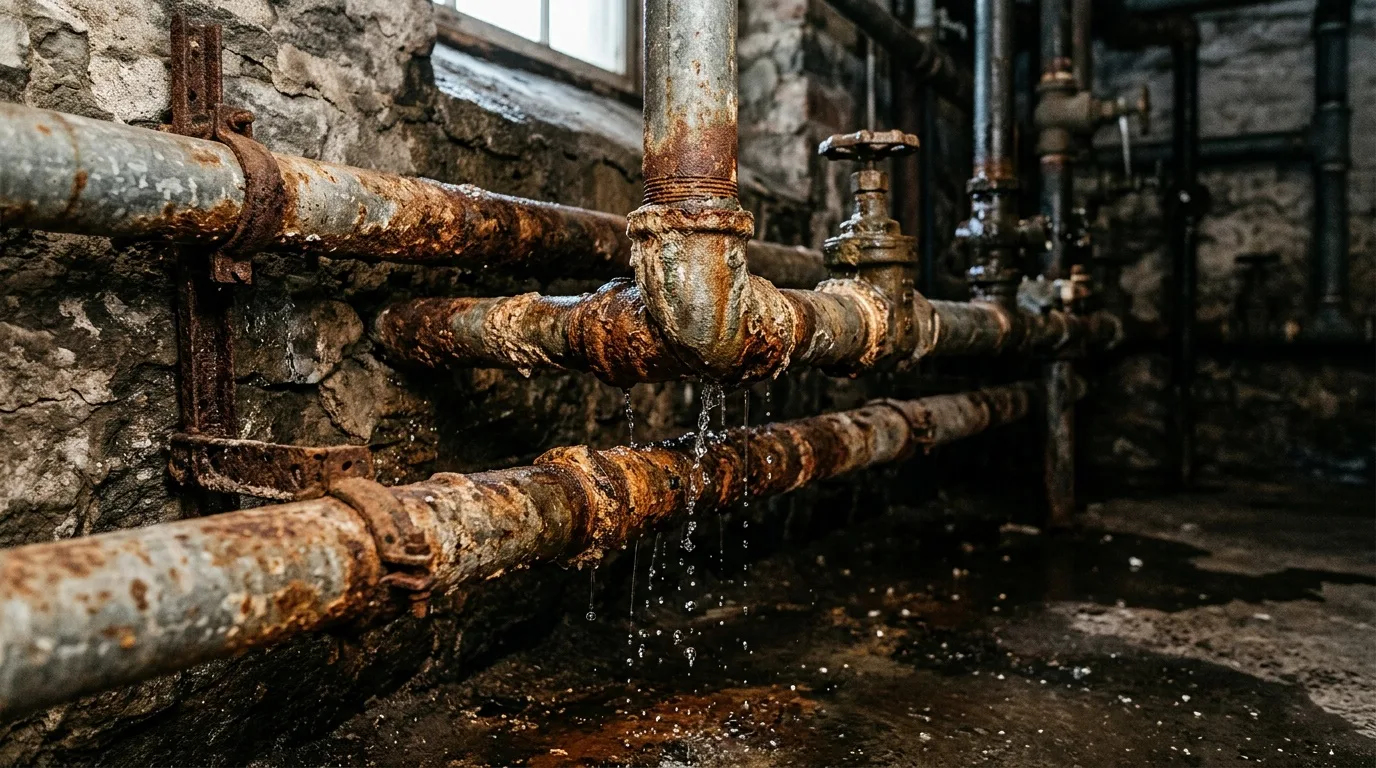
Nothing lasts forever, pipes included. A leak in the water supply can show up right after a remodel or after many years of service. Old steel lines, plain or galvanized, are a common source of trouble in older homes, and the problems they cause tend to come in a set: rusty water, weak flow, and then leaks.
Sometimes rusty water from the tap is a short-lived thing you can ignore. In other cases it is a serious problem that needs to be dealt with as soon as possible. Below we go through how to tell what you have with galvanized pipes in your home, why they fail, and what to do when one starts leaking inside a wall.
How to Recognize Galvanized Pipe
Galvanized pipe is steel pipe with a zinc coating. Sections are joined with threaded fittings: the pipe end is threaded and screwed into a coupling, elbow or tee. Usually, the threads are cut after the pipe is galvanized. That means the cut thread is the place where the zinc layer is thinnest or missing altogether.
In practice, look for:
- Threaded joints. Fittings screwed onto the pipe rather than soldered or crimped.
- Rust at the joints. Over time the joints of steel or galvanized pipes get covered with rust.
- Rust spots along the pipe. Spots where water slowly starts to seep out.
The quickest test: scratch the pipe with a key or a flat screwdriver and hold a strong magnet to it. Galvanized steel stays dull gray under the scratch and the magnet sticks; copper shows a penny color, and a magnet does not stick to copper or plastic.
Rust and Discolored Water
Rusty water is tap water with a noticeable reddish or brown tint caused by a high iron content. You can usually spot it by the orange or light-brown color. Too much iron spoils the taste, smell and quality of the water.
Orange or brown water can come out of the tap for several reasons:
- Old metal pipes. Over time old metal pipes oxidize and rust forms inside them.
- Work on the system. After pressure testing, flushing or pipe repairs, the water may change color for a while — settled rust and deposits get stirred up and reach the taps. This is usually temporary, and the water clears after a short run.
- Sand and silt. Sand, silt and fine particles that build up in the pipes encourage corrosion and rust.
When the water utility repairs its lines, the system is drained and then refilled, and the flow can tear the rust growths and other deposits off the joints. In that case you just run the water until it is clear. But that does not solve the problem — the rust in the pipes is not going anywhere.
If the water is colored after a temporary shutoff, run it for a few minutes. Usually that is enough. If it does not help (or there was no long or emergency shutoff in the first place), you need to find the cause. When rusty water comes out only in your home, the cause may be in the faucets, supply lines or other plumbing inside the house. If the neighbors have it too, the problem is more likely in the main.
Do not drink rusty water or cook with it, even after boiling. Heating only kills bacteria; it does not remove the iron compounds. Until the cause is found, use other water for drinking and food.
Constant contact with rusty water also corrodes the inner parts of appliances and shortens their life. The washing machine ends up being repaired more often; water heaters and dishwashers suffer too. Rusty water also stains light-colored laundry, leaves marks on sinks and tubs, and clogs faucet aerators and cartridges.
Low Water Pressure in Galvanized Pipes
The term "pressure" is not quite right here — it is more correct to talk about the flow capacity of the pipe. Pressure is a measure of force. For example, a faucet can be connected to a system with high pressure but low capacity. When you open it, the water first spurts hard because it is under pressure, and then runs in a thin stream because the pipe cannot carry more.
Old water pipes that have gone several decades without repair usually clog with scale, rust and other deposits. In the end the inside diameter of the pipe shrinks so much that only a narrow gap is left for the water to pass through. Pressure drops noticeably, and the water from the faucet can smell of rust. In those places the pipe wall also becomes thin.
With weak flow, first check the simple things:
- Aerators. Every modern faucet has one, and it needs to be unscrewed and cleaned from time to time. After the water has been shut off for work, the aerator can catch sand or rust and clog.
- The sediment strainer. If your home has one, a coarse filter installed where the supply line enters the house. It catches insoluble dirt such as small stones and sand, and a clogged screen is a common cause.
- The pressure regulator. If the water carries impurities, the regulator can fail and stop controlling the pressure.
Plumbers measure pressure with a gauge connected to the pipes. If the aerators, filters, meter and valves are all fine, a plumber looks at the deposits in the pipes and decides whether flushing will do or a full replacement is needed.
How Galvanized Pipes Fail: Threads and Joints
In any structure the joint is the weak point. This is especially true where different materials meet — metal and plastic, for example. But a pinhole can also open on a straight run of pipe.
The main causes of leaks in old galvanized pipes are:
- Rust. Iron oxides form where metal is in contact with water. A rust spot can be barely visible at first and come from a factory defect or mechanical damage. Over time corrosion thins the metal.
- Installation mistakes. The most vulnerable places are the joints and seams. That is where leaks often start.
- Temperature swings. Sudden temperature changes are also bad for pipes.
- Mechanical damage. Pipes, especially full ones, can be damaged by a careless blow with a tool or by something heavy falling on them.
Rust spots can eat through the pipe wall until it starts to drip or bursts. A burst can flood your own home and, in a duplex or condo, the neighbors too. Old steel pipes can start to leak at any moment and ruin a fresh remodel, so it makes sense to deal with them before finishing work, not after.
Partial vs. Full Repipe
A partial repipe replaces only the failing runs, for example the line to one bathroom; a full repipe replaces all the supply piping in the house, usually with copper or PEX. With galvanized pipe, a patch tends to move the leak to the next old section, so once leaks start, owners of older homes often go for a full repipe. Before the walls are closed up in a remodel, the system should be checked for leaks and wear. A plumber should inspect the accessible sections and test the system under pressure. Hidden pipes cannot be fully checked without opening the tile or drywall; a thermal camera, a moisture meter and acoustic leak detection help find signs of a leak.
Grounds for galvanized pipes replacement:
- Pinhole leaks through the wall of the pipe.
- Deep corrosion.
- Constant drips and wet joints.
A full replacement of the piping makes sense with repeated leaks, heavy corrosion and many hidden joints. When new pipe goes in, plan access to the valves and joints, and check the system for leaks before closing the walls.
If the problem section is clogged with deposits, it needs full replacement — patching one spot does not bring the inside diameter back. Before hiring anyone for the work, use the CSLB contractor license check to confirm the plumbing contractor's license.
Old Galvanized Pipes Leaking in Walls and Under the House
Leaks are also unpleasant because sometimes it all starts with a small drip somewhere hard to reach. Under the tub, at the bottom of a cabinet, in hidden piping. By the time someone notices water coming through a ceiling, the leak may have been running for a long time. It is doubly bad when the leak has also damaged your interior, including by starting mold.
For hidden pipes, you first need to find where the leak is. That takes an instrument — a sensitive infrared thermal imager or a non-contact moisture scanner. A thermal imager shows the warmest areas of a room and works for finding leaks in hidden hot-water pipes. Then the finish has to be opened up to get to the damaged section. If you are dealing with this now, our page on water damage restoration in El Cajon explains what that work involves.
Before any work, shut off the water at the main valve, and keep away from wet outlets and wiring. There are several stopgap fixes for a pipe leaking under pressure, but they are all temporary. Some can hold for a couple of months, others will start leaking again in a couple of days. Do not put off calling a plumber.
- Repair clamp. Hardware stores sell a pipe repair clamp made of a galvanized metal plate, a rubber gasket and nuts with bolts. The gasket is pressed tight against the leak, the clamp goes on top and the nuts are tightened with a wrench. Measure the pipe diameter first, or the clamp may be too big to press the hole shut.
- Pipe repair tape. When wound on, the tape contracts and squeezes the hole tight.
Drying After a Leak
Moisture damages walls, and living with it for a long time can affect your health. Once the leak is stopped, the wall has to dry completely, or mold will come back. Our guide on why fast water extraction saves floors covers the first hours after a leak.
- Use a dehumidifier. Turn it on when humidity is high; dedicated dehumidifiers are very effective.
- Small mold spots. If a little mold has appeared, wear gloves, open a window and wipe the painted wall with a mold remover or a diluted bleach solution (never mixed with ammonia or other cleaners), leave it, then wipe with clean water. If the mold comes back or will not come off, the moisture or growth is likely inside the wall, so have it checked.
Larger growth is a separate job — see how mold remediation works. If furniture and belongings need to be moved out while walls are opened and dried, read about our pack-out and contents services.
More From Our Team
You can learn who we are and how we work, read what El Cajon homeowners say about us, browse more articles on water and mold, or go back to the water damage restoration home page.